Homeowner guide
How Your Central A/C System Works
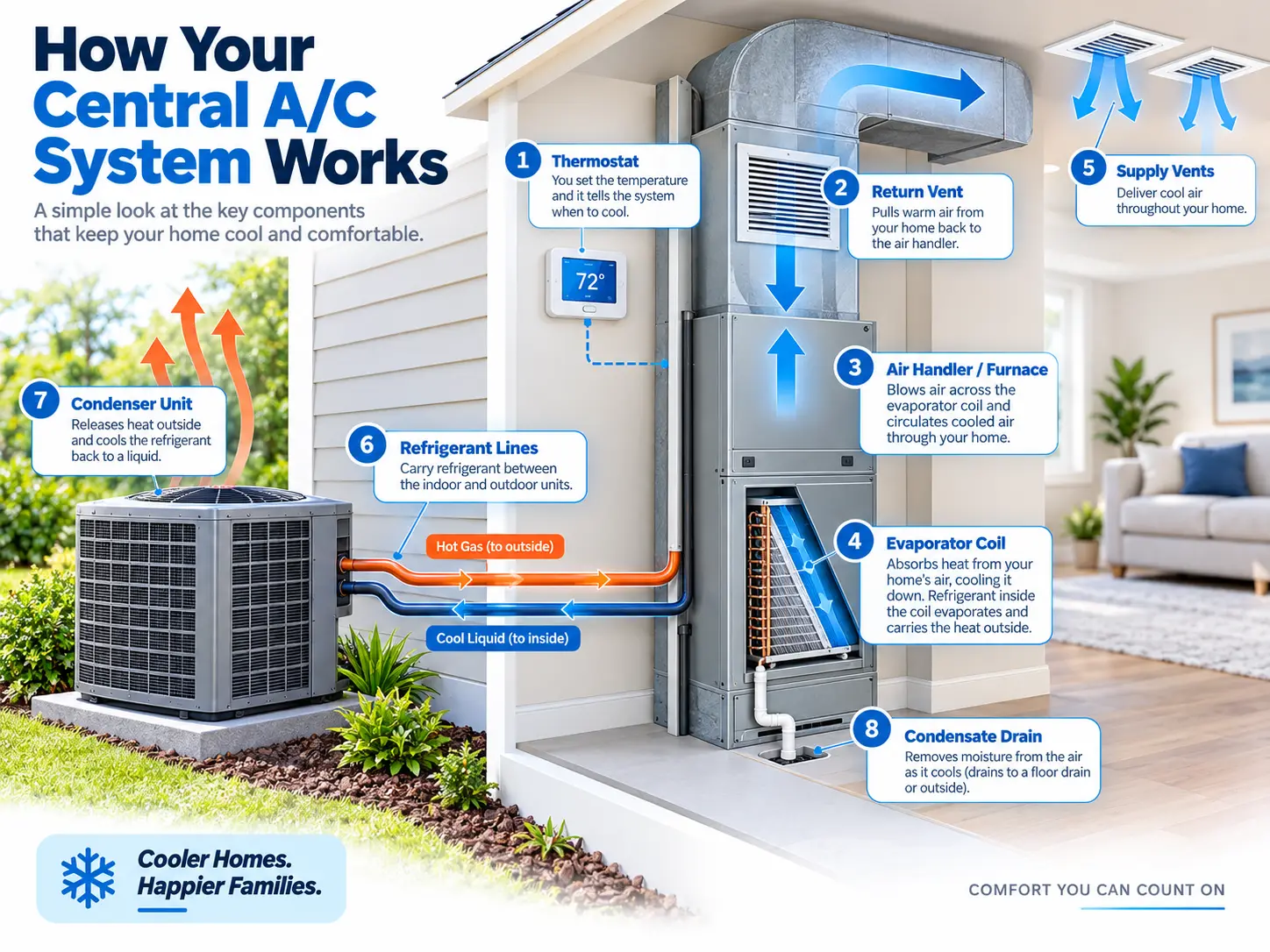
Air conditioning does not create cold air; it moves heat out of your house. Once that clicks, most cooling problems start making sense. The diagram below labels the eight parts that matter.
The eight components in the diagram
- 1. Thermostat — you set the temperature, and it tells the system when to cool
- 2. Return vent — pulls warm air from your home back to the air handler
- 3. Air handler / furnace — blows air across the evaporator coil and circulates cooled air through your home
- 4. Evaporator coil — absorbs heat from your home's air; refrigerant inside evaporates and carries that heat outside
- 5. Supply vents — deliver the cooled air back into your rooms
- 6. Refrigerant lines — carry refrigerant between the indoor and outdoor units
- 7. Condenser unit — releases heat outside and cools the refrigerant back into a liquid
- 8. Condensate drain — removes the moisture pulled out of the air as it cools
Follow the loop once
The thermostat closes a circuit calling for cooling. The blower in the air handler starts, pulling warm indoor air through the return grille and filter, then pushing it across the cold evaporator coil.
Inside that coil, low-pressure liquid refrigerant boils as it absorbs heat from your air. The now-cool, drier air travels through the ducts to your supply vents, while the refrigerant — now a warm vapor — travels through the suction line to the outdoor unit.
In the condenser, the compressor raises the refrigerant's pressure and temperature so it is hotter than the outdoor air. The condenser fan pushes air across the outdoor coil, the refrigerant sheds its heat and turns back into a liquid, and the cycle repeats. All summer, your air conditioner is essentially a heat pump moving indoor heat outdoors.
The moisture half of the job
The coil surface sits below the dew point of your indoor air, so water condenses on it exactly the way it beads on a cold glass. That water drips into a pan and exits through the condensate drain.
In McAllen's humidity, that can mean gallons a day. This is why dehumidification matters as much as temperature here, and why drain problems are one of the most common causes of a system shutting itself off.
What each part's failure looks like
- Thermostat: blank screen, readings that disagree with the room, system that will not start or stop
- Return vent or filter: weak airflow at every vent, coil freezing
- Air handler blower: no air movement, squealing, or reduced airflow throughout
- Evaporator coil: ice buildup, musty odors, refrigerant leaks
- Supply vents and ducts: some rooms cool while others stay warm
- Refrigerant lines: oily residue, hissing, frost on the suction line
- Condenser: fan not spinning, humming with no start, high pressures, breaker trips
- Condensate drain: water around the air handler, ceiling stains, system shutting off and restarting later
Why this matters in South Texas
An air conditioner can only reject heat if the outdoor air is cooler than the refrigerant in the condenser coil. On a 100-degree Valley afternoon, that margin narrows, so anything that reduces heat rejection — a dirty coil, restricted airflow, a struggling fan motor — has an outsized effect right when you need cooling most.
The same is true indoors. Attic ductwork surrounded by very hot summer air makes leaks costly, and high humidity means the coil and drain are working constantly. Understanding the loop makes it obvious why maintenance focuses on airflow, clean coils, correct charge, and clear drains.
Still not cooling? Talk to a local provider
If the checks above have not solved the problem, a technician can measure airflow and refrigerant pressures and identify the cause quickly. Same-day availability depends on provider participation, location, technician availability, and demand.
Answers
Questions homeowners ask
Keep reading
More helpful guides
Talk to someone
Need cooling help in McAllen today?
Call for the fastest answer on availability, or send a request and a local provider can follow up.
Same-day and 24/7 emergency services are subject to provider participation, location, technician availability, and demand.