
McAllen homeowner guide
Does My AC Need Freon? What McAllen Homeowners Should Know
Refrigerant is contained inside a closed air-conditioning system and is not normally something that should need routine topping off. If a system is confirmed to be low, it is worth asking why the level dropped.
Same-day and 24/7 emergency services are subject to provider participation, location, technician availability, and demand.
Refrigerant is not fuel
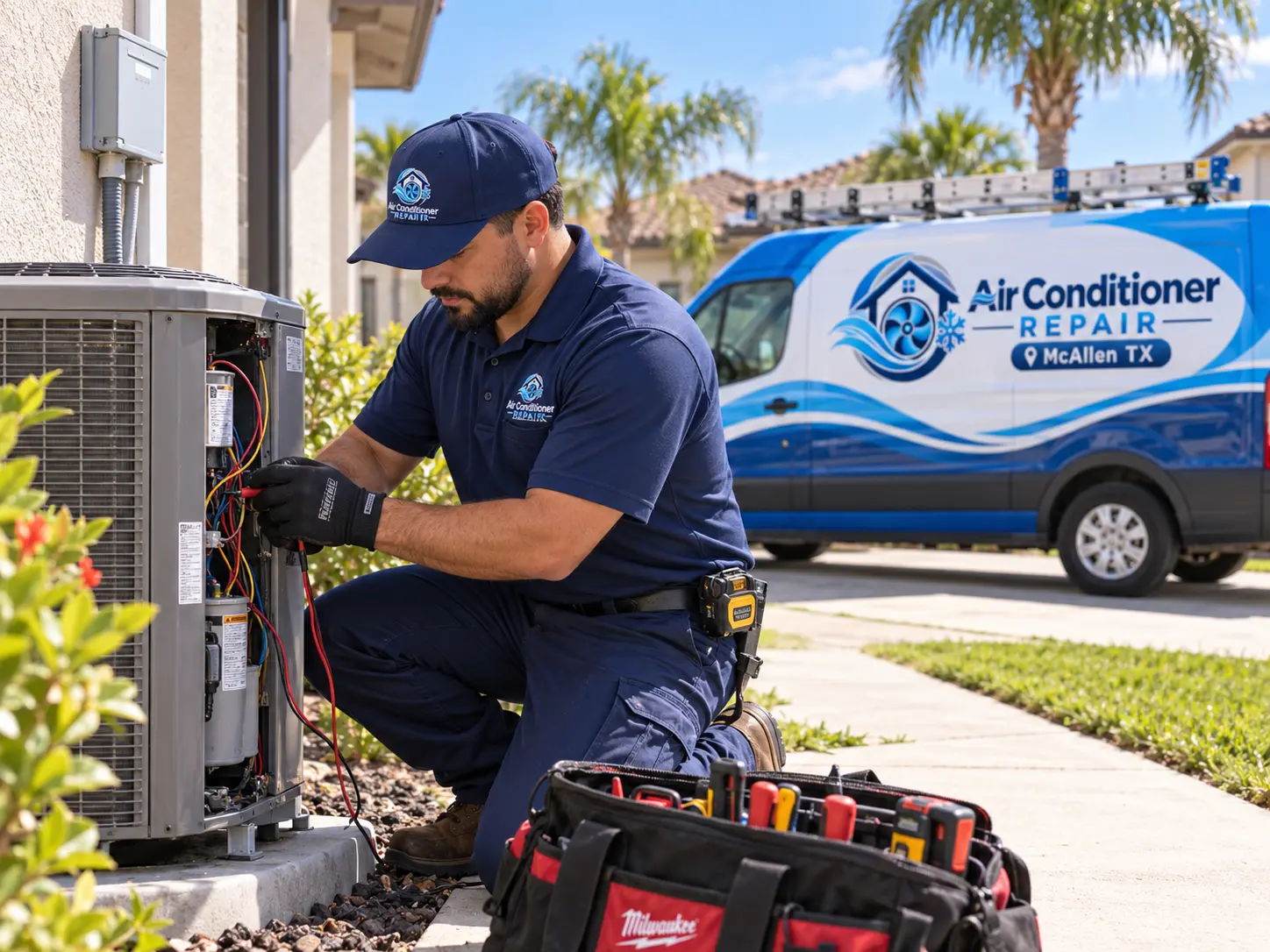
Air conditioners do not consume refrigerant the way an engine consumes gasoline. The refrigerant circulates in a sealed loop between the indoor coil and the outdoor unit, changing between liquid and vapor to move heat out of the house.
Because the loop is closed, a properly charged system should hold its charge for years. A confirmed low charge means refrigerant escaped somewhere, so the useful question is where — not simply how much to add.
Homeowners often call all refrigerant 'Freon,' which was a brand name associated with older R-22 systems. Most systems installed in recent years use R-410A or a newer blend, and older R-22 equipment can be significantly more expensive to recharge.
Problems that can feel like low refrigerant
Each of these can produce weak cooling, long runtime, and even ice formation — the same symptoms homeowners associate with needing refrigerant. That overlap is exactly why measurement matters before charge is added.
- Dirty air filter
- Dirty evaporator coil
- Dirty outdoor coil
- Low airflow
- Blower problem
- Thermostat issue
- Frozen coil
- Duct leakage
Possible refrigerant-related signs
- Poor cooling
- Very long runtime
- Ice or frost on the lines or coil
- Hissing sounds
- Higher energy use
- Reduced temperature difference between return and supply air
Worth asking
How a provider confirms a charge problem
- Verifying airflow and filter condition before touching the refrigerant circuit
- Measuring suction and liquid pressures with gauges
- Calculating superheat and subcooling against manufacturer targets
- Inspecting the coil, line set, service valves, and fittings for oil residue
- Using electronic leak detection, bubble solution, or dye when a leak is suspected
- Documenting how much refrigerant was recovered and added
Why repeated recharging is a short-term answer
Adding refrigerant to a leaking system restores cooling for a while, but the charge will drop again and the underlying leak usually grows. Running with a low charge can also overheat the compressor, turning a moderate repair into a major one.
There is a cost consideration too. Several recharges over two or three summers can add up to more than a proper leak repair would have cost, especially on older equipment.
- 1Ask for the measured pressures and what they indicate.
- 2Ask whether a leak search was performed and what was found.
- 3Ask for the repair options, including sealing, component replacement, or coil replacement.
- 4Ask whether the coil or compressor may still be under manufacturer warranty.
- 5Ask what the expected outcome is if only refrigerant is added.
Please do not attempt this yourself
Refrigerant work is regulated and requires certification, proper recovery equipment, and accurate charging by weight or by measured superheat and subcooling. Store-bought sealants and top-off kits can contaminate a system and complicate a later repair.
This guide is intended to help you ask better questions, not to describe a DIY procedure. Any refrigerant handling should be left to a qualified technician.
Told your AC 'just needs Freon' again?
Ask what is causing the loss. An independent local provider can perform a leak search and explain the findings before adding refrigerant.
Answers
Questions McAllen homeowners ask
Does AC refrigerant need to be topped off every year?
No. Refrigerant circulates in a closed system and is not consumed during normal operation. Annual top-offs generally indicate a leak that has not been located and repaired.
Why does my AC keep needing Freon?
Repeated low charge points to a leak somewhere in the sealed system — commonly at the evaporator coil, a fitting, a service valve, or along the line set. Locating and repairing the leak addresses the cause rather than the symptom.
How can I tell if my AC has a refrigerant leak?
Possible signs include cooling that faded gradually over weeks, ice or frost on the suction line or indoor coil, hissing near the coil, oily residue at fittings, longer runtime, and a smaller temperature difference between return and supply air. Confirmation requires gauges and a leak search.
Is it safe to keep running an AC that is low on refrigerant?
It is not ideal. Operating with a low charge can cause coil freezing and can overheat the compressor, which is one of the most expensive components in the system. Having the cause investigated sooner usually costs less than waiting.
Keep reading
Related pages and guides
Signs of an AC Refrigerant Leak in McAllen
Symptoms, common leak locations, and repair options.
Read more →Refrigerant Leak Repair in McAllen TX
Request a leak search and repair from a local provider.
Read more →AC Not Cooling? Common Causes
The airflow issues that mimic low refrigerant.
Read more →Why Air Conditioners Freeze Up
How ice forms and what it usually means.
Read more →Talk to someone
Need cooling help in McAllen today?
Call for the fastest answer on availability, or send a request and a local provider can follow up.
Same-day and 24/7 emergency services are subject to provider participation, location, technician availability, and demand.