
McAllen homeowner guide
Signs of an AC Refrigerant Leak in McAllen, TX
A refrigerant leak rarely announces itself. It usually shows up as cooling that quietly got worse over several weeks, along with a few physical clues around the equipment.
Same-day and 24/7 emergency services are subject to provider participation, location, technician availability, and demand.
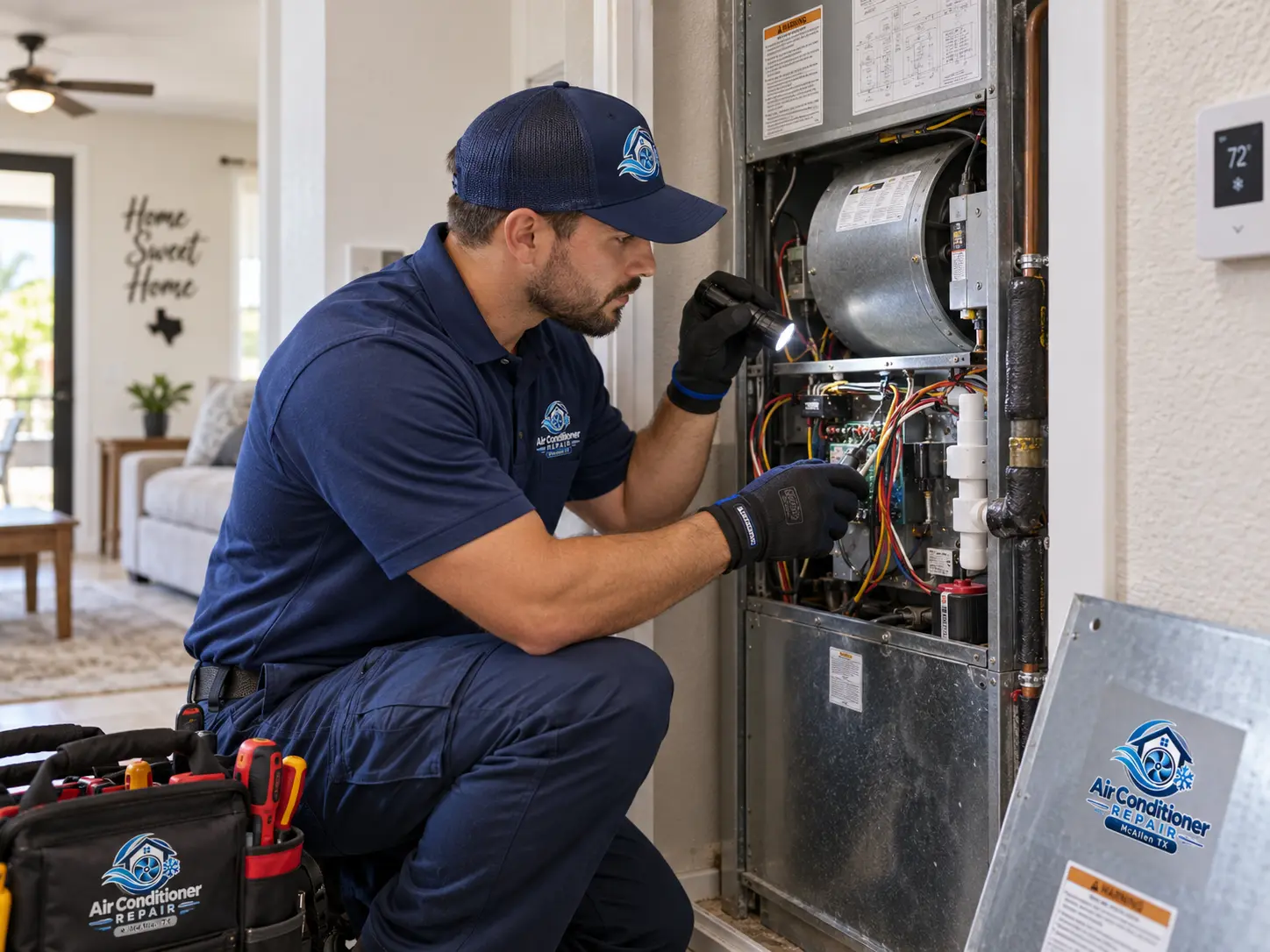
How a leak usually presents
Most residential refrigerant leaks are slow. Cooling capacity fades over weeks, so the change is easy to blame on hotter weather — which is why leaks often go unnoticed until a Valley heat wave exposes them.
As charge drops, the coil runs colder than designed in places and can begin forming frost. Airflow then falls, cooling drops further, and the compressor works harder against poor conditions.
- Cooling that got gradually worse rather than failing suddenly
- Ice or frost on the copper suction line or the indoor coil
- A hissing or bubbling sound near the indoor unit
- Oily residue at fittings, service valves, or along the line set
- Longer runtime and rising electricity use
- A reduced temperature difference between return and supply air
- A system that cools well early in the morning and poorly by afternoon
Where leaks commonly develop
Coastal and semi-humid conditions, cleaning-product vapors, and long run hours all contribute to coil corrosion over time. Age matters: a system past the ten-to-fifteen-year mark is statistically more likely to develop a coil leak.
- Evaporator coil tubing, including formicary corrosion pinholes
- Brazed joints and flare fittings at the indoor and outdoor units
- Schrader valve cores and service port caps
- The line set where it passes through walls or attic framing
- Condenser coil damage from impact, weed trimmers, or corrosion
- The accumulator, filter drier, or reversing valve on heat pump systems
How leaks are located
- 1Verify airflow, filter condition, and coil cleanliness so airflow problems are not mistaken for low charge.
- 2Measure operating pressures and calculate superheat and subcooling.
- 3Inspect accessible components visually for oil traces and physical damage.
- 4Use an electronic detector, bubble solution, or ultraviolet dye to pinpoint the source.
- 5Pressure test with nitrogen when a leak is suspected but not visible.
- 6Repair or replace the failed component, evacuate the system, and charge to the manufacturer's specification.
Ask for the findings
Repair, coil replacement, or system replacement
An accessible fitting leak is often a straightforward repair. A leaking evaporator coil is a larger job, and on older equipment the coil cost plus refrigerant cost can approach a meaningful share of replacement cost.
Systems that still use R-22 deserve a careful cost conversation, because that refrigerant is no longer produced and recharging can be expensive. A provider should present both the repair path and the replacement path with numbers, so you can compare.
- Component or fitting repair — usually the least disruptive option
- Evaporator coil replacement — common on mid-life systems with coil corrosion
- Full system replacement — worth comparing when the system is older or has repeated failures
- Warranty check — coils and compressors often carry long parts warranties
Is a leak a safety concern?
Common residential refrigerants are not intended to be inhaled, and a large release in an enclosed space can displace oxygen. If you hear a strong hissing sound and smell something chemical near the air handler, turn the system off, ventilate the area, and request service.
The more typical concern is equipment damage. Running a compressor with an inadequate charge shortens its life, which is why a suspected leak is worth having inspected rather than ignored.
Suspect a refrigerant leak?
A provider can measure pressures, search for the leak, and explain repair options before any refrigerant is added.
Answers
Questions McAllen homeowners ask
How can I tell if my AC has a refrigerant leak?
Look for cooling that declined gradually, ice or frost on the suction line or indoor coil, hissing near the coil, oily residue at fittings, and longer runtime with higher energy use. Confirmation requires gauge readings and a leak search by a technician.
Can a refrigerant leak be repaired, or does the AC need replacing?
Many leaks are repairable, especially at fittings, valves, and accessible joints. A corroded evaporator coil usually needs replacement, and on older systems the combined cost can make replacement worth comparing.
How long does refrigerant leak repair take?
A simple fitting repair with recovery, evacuation, and recharge can often be completed in a single visit. Coil replacement may take longer and can depend on part availability for the specific model.
Is a leak search always successful?
Not always. Very small leaks can take more than one visit to locate, and some leaks only show up under specific pressures or temperatures. A technician should explain what was tested and what the next step would be.
Will adding refrigerant fix the problem?
It restores cooling temporarily but does not address the leak. The charge will drop again, and running low can damage the compressor, so locating the leak is the more durable approach.
Keep reading
Related pages and guides
Does My AC Need Freon?
Why refrigerant should not need routine topping off.
Read more →Refrigerant Leak Repair in McAllen TX
Request a leak search from an independent provider.
Read more →Why Air Conditioners Freeze Up
Ice on the coil and what causes it.
Read more →AC Repair vs Replacement in McAllen
Compare a coil repair against a system change.
Read more →Talk to someone
Need cooling help in McAllen today?
Call for the fastest answer on availability, or send a request and a local provider can follow up.
Same-day and 24/7 emergency services are subject to provider participation, location, technician availability, and demand.