
Homeowner guide
AC Not Cooling? Common Causes in McAllen Homes
Your system is running, air is moving, and the house keeps getting warmer. Here is what is usually happening — ordered from the most common cause to the least.
1. A restricted air filter
A dirty or restricted air filter is one of the easiest and most common airflow issues to rule out. Some filters may require more frequent inspection or replacement depending on dust levels, pets, runtime, filter type, and household conditions.
A clogged filter starves the evaporator coil of warm return air. The coil gets too cold, condensate freezes on it, and airflow drops further — a loop that ends with a solid block of ice and no cooling at all.
- Hold the filter up to a light; if you cannot see light through it, replace it
- Note the size printed on the frame so you can keep spares
- Set a phone reminder rather than checking by memory
2. A frozen evaporator coil
If you see frost on the copper line at the indoor unit or ice on the coil, the system cannot move air across the coil. Turn cooling Off and set the fan to On — running the blower without the compressor thaws the coil faster than shutting everything down.
Freezing has two root causes: restricted airflow or low refrigerant charge. Thawing restores cooling temporarily, but the underlying cause needs to be found or it will freeze again within a day or two.
3. A failed capacitor
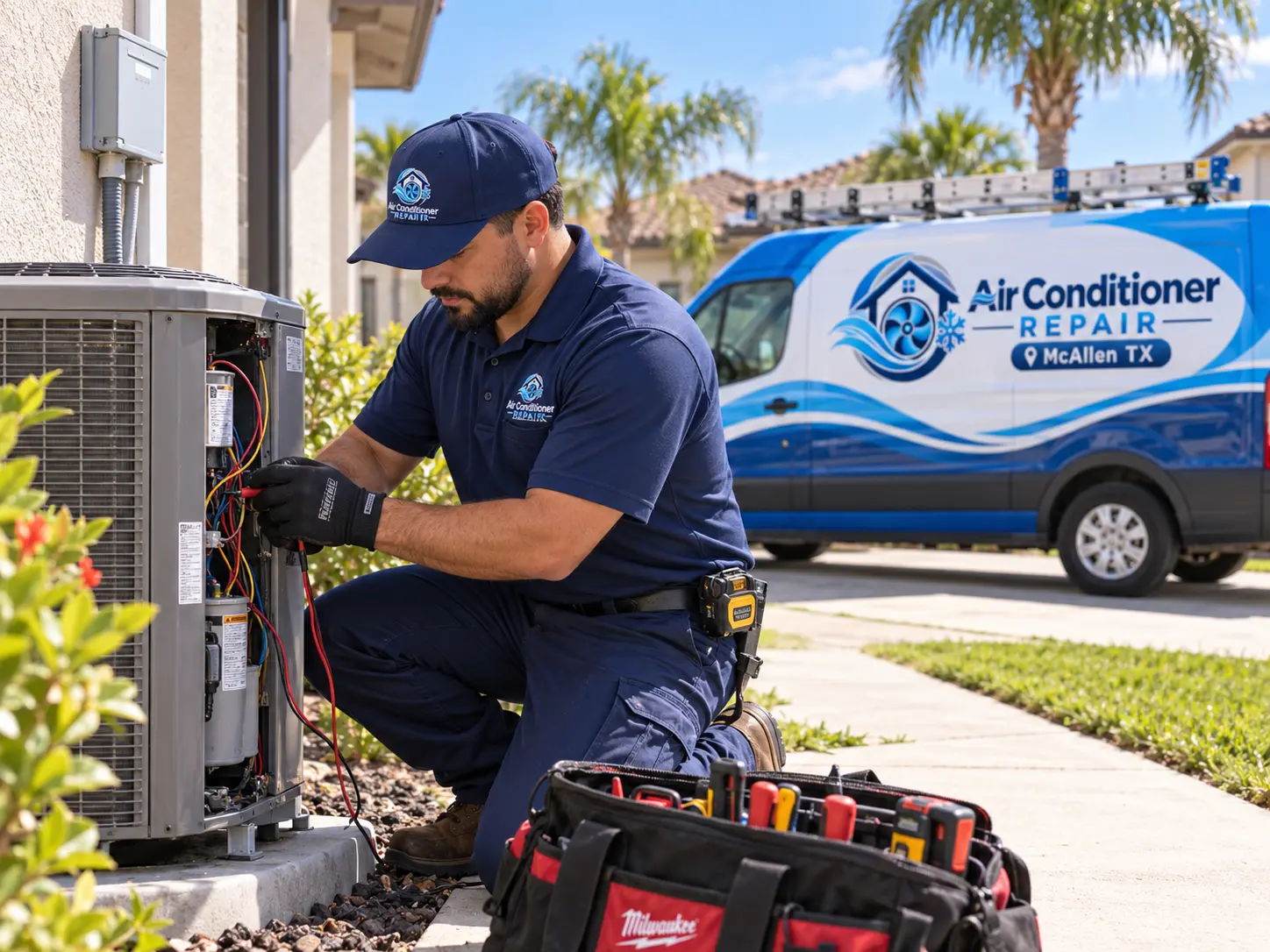
If the outdoor fan spins but the compressor never starts — or the fan hums without turning — a run capacitor has likely failed. Heat is the enemy of capacitors, and McAllen summers age them quickly.
This is a common, relatively inexpensive repair, but it involves stored electrical energy and should be left to a technician.
4. A clogged condensate drain
Attic and closet air handlers drain a lot of water in Valley humidity. When the line clogs with biological growth, the pan fills, and a float switch shuts the system off to prevent ceiling damage.
The tell-tale sign is a system that stops entirely, then works again hours later after water drains past the blockage. Flushing the line and testing the switch is the correct fix.
5. Low refrigerant from a leak
Refrigerant is not consumed. If the charge is low, there is a leak. Symptoms include cooling that faded gradually over weeks, ice on the suction line, a small temperature split at the vents, and hissing near the coil.
Adding refrigerant without locating the leak is a temporary patch. Running low on charge also overheats the compressor, so this one should not wait.
6. A dirty outdoor condenser coil
The outdoor unit rejects heat to the air. When its coil is matted with dust, grass clippings, or cottonwood fluff, it cannot shed heat, pressures rise, and cooling capacity falls — sometimes dramatically on a 100-degree afternoon.
You can gently rinse the outer coil with a garden hose after shutting off power. Never use a pressure washer, and never bend the fins.
7. Duct leakage in a hot attic
If some rooms cool and others do not, the equipment may be fine while the delivery system is not. Attics in South Texas can become extremely hot during summer, so a separated duct connection can dump cooling into the attic and pull very hot air into the supply stream.
Sealing plenum joints and repairing crushed flex runs often restores comfort without touching the equipment.
8. Thermostat and control problems
A miscalibrated thermostat, a failing sensor, or a thermostat mounted in afternoon sun can make a healthy system appear broken. Before assuming a mechanical failure, compare the thermostat reading against an independent thermometer in the same room.
What to check before you call
- Thermostat set to Cool, with a set point at least three degrees below room temperature
- Filter clean and correctly installed
- Breaker on at the panel and the outdoor disconnect engaged
- No ice on the coil or refrigerant lines
- All supply and return vents open and unblocked
- Outdoor unit clear of debris with the fan spinning
Still not cooling? Talk to a local provider
If the checks above have not solved the problem, a technician can measure airflow and refrigerant pressures and identify the cause quickly. Same-day availability depends on provider participation, location, technician availability, and demand.
Answers
Questions homeowners ask
Keep reading
More helpful guides
Talk to someone
Need cooling help in McAllen today?
Call for the fastest answer on availability, or send a request and a local provider can follow up.
Same-day and 24/7 emergency services are subject to provider participation, location, technician availability, and demand.